
At first glance, the q_rsqrt function in the Quake III Arena source code looks like a programmer’s prank. It features a handful of bit twiddles, a mysterious hexadecimal constant, and a single Newton refinement.
Yet, that odd little routine – the Fast Inverse Square Root – was called millions of times rendering 3D environments. It helped shape the performance of one of the most influential 3D engines of the late 1990s. Today, we’re unpacking the origin of this “magic,” how it exploited the laws of physics and floating-point math, and why it eventually became a piece of programming lore.
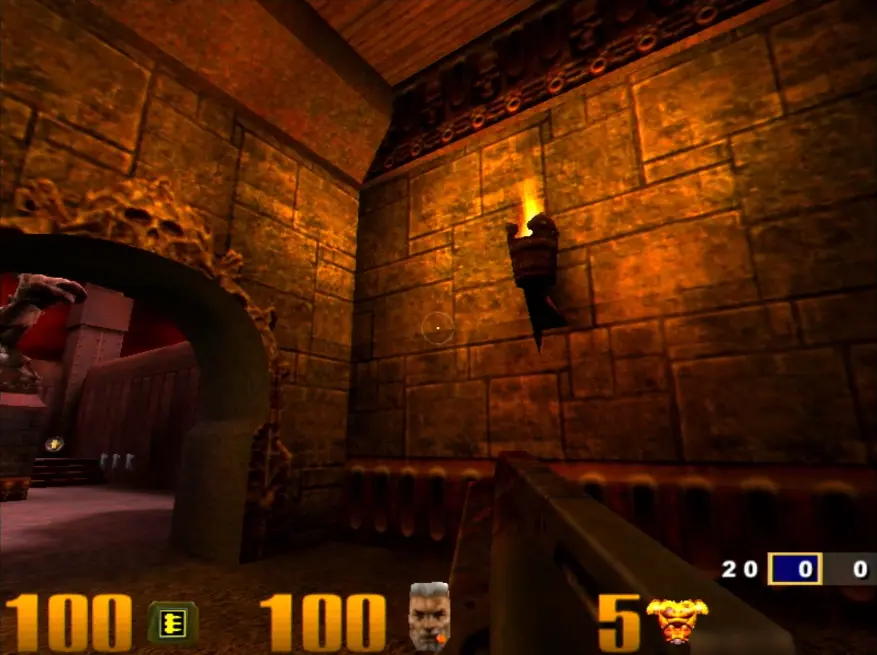
The Problem: The 60 FPS Barrier
In the 90s, 3D graphics relied heavily on vector normalization. To calculate how light hits a surface, the engine needs to calculate

On modern hardware, this is cheap. In 1999, it was a performance killer. Calculating a square root on a 90s microprocessor took many compute cycles. If you needed to do this thousands of times per frame, you could say goodbye to a smooth 60 FPS. Developers needed a shortcut that used integer operations instead of heavy floating-point math.
A Short History of the “Trick”
Contrary to popular belief, this code didn’t just appear out of thin air at id Software. Its lineage traces back to the 1980s:
- 1986: William Kahan (the “father of IEEE-754”) explores bit-fiddling for square roots.
- The 90s: Greg Walsh is often credited with deriving the specific “magic constant” that made the approximation work on consumer hardware.
- The Legend: The algorithm eventually migrated into id Software’s Quake III source, where it was immortalized with the infamous comment:
// what the f***?
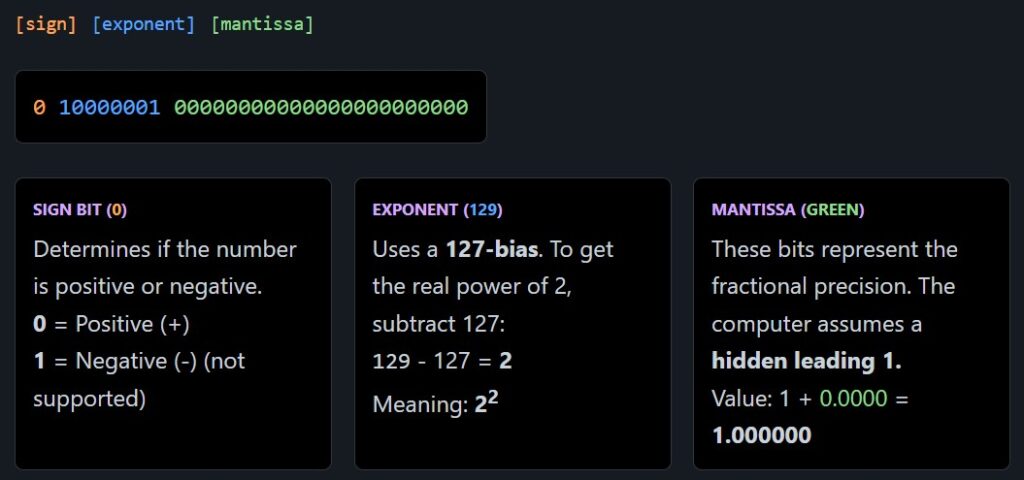
How it Works (In Plain English)
A 32-bit float is made of three parts: a sign bit, an exponent, and a mantissa. The trick treats those bits as if they were a regular integer, performs a simple subtraction, and then turns them back into a float.
// The Legend in C code
float Q_rsqrt( float number ) {
    long i;
    float x2, y;
    const float threehalfs = 1.5F;

    x2 = number * 0.5F;
    y  = number;
    i  = * ( long * ) &y;                       // evil floating point bit level hacking
    i  = 0x5f3759df - ( i >> 1 );               // what the f***?
    y  = * ( float * ) &i;
    y  = y * ( threehalfs - ( x2 * y * y ) );   // 1st iteration

    return y;
}
The Magic Constant: 0x5f3759df
This hexadecimal number is the “secret sauce.” By subtracting the bit-shifted float from this constant, the code arrives at a “first guess” that is shockingly close to the real answer. A single Newton-Raphson iteration (the last line of code) then cleans up the remaining error to make it visually perfect for a video game.
Benchmarks: Does it Actually Help?
To see if this “hack” actually mattered, we can look at performance on vintage CPUs. Interestingly, the results depend entirely on your hardware:
| CPU | Iterations | Standard Math | Fast Inverse Sqrt | Result |
|---|---|---|---|---|
| 386DX-33 (no FPU) | 10.000 | 5108ms | 7250ms | Slower |
| 386DX-33 (with FPU) | 10.000 | 110ms | 220ms | Slower |
| 486DX2-66 (with FPU) | 100.000 | 384ms | 330ms | Faster |
| 486DX2-66 (no FPU) | 100.000 | 1538ms | 2032ms | Slower |
On a 386, the integer-to-float conversion was so slow it actually hindered the process. But on the 486 and the early Pentiums, the “bit-hack” provided the crucial speed boost needed to keep the engine running fast.
Visual Proof: Accuracy vs. Speed
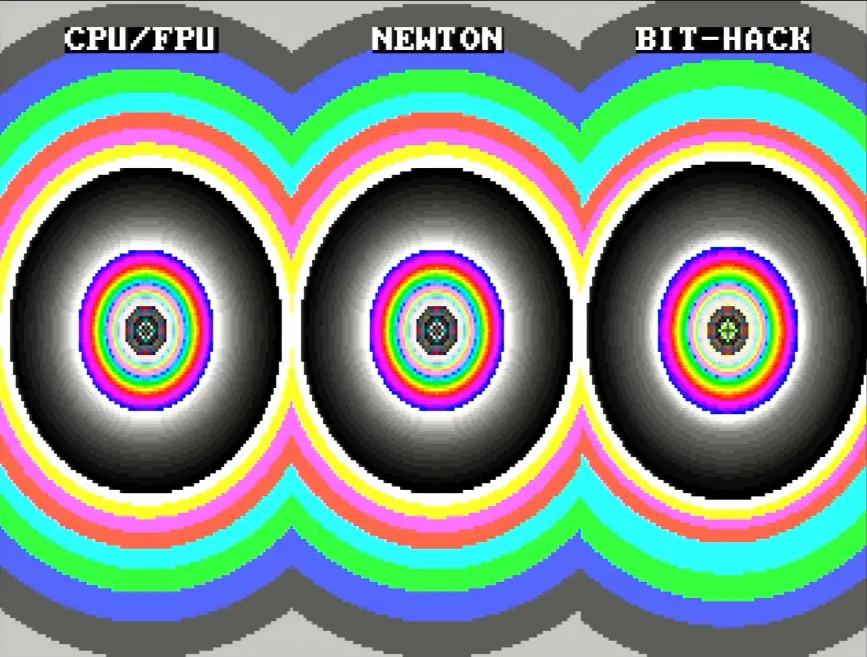
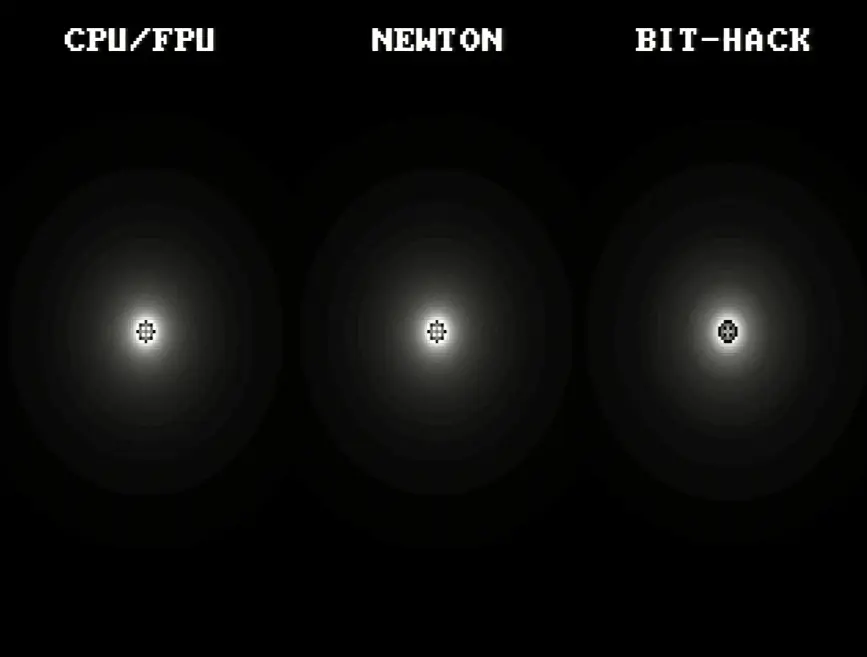
Is the approximation “good enough”? When rendering circles, the difference is clear:
- Standard Math: Perfect gradients.
- Quake III (with Newton): Identical to the eye.
- No Newton Refinement: Visible artifacts, darker centers, and “banding” in the colors.
This explains why the developers kept that final line of math – it was the bridge between “fast but broken” and “fast and beautiful.”
Final Thoughts
This routine is more than just a clever hack; it’s a reminder of a time when every single cycle mattered. It shows how deep knowledge of hardware can produce elegant, if slightly mysterious, solutions.